Diffractive waveguide manufacturing depends on adhesive behavior as much as on waveguide design. In AR and micro-nano optics, small material changes can shift coupling efficiency, image uniformity, and long-term stability.
Outline
- What optical adhesive must achieve in diffractive waveguides
- Eight specifications that affect performance and yield
- How to compare candidate materials
- Where optical interface materials fit in the supply chain
- FAQ for engineers and procurement teams
What Optical Adhesive Does in Diffractive Waveguide Manufacturing
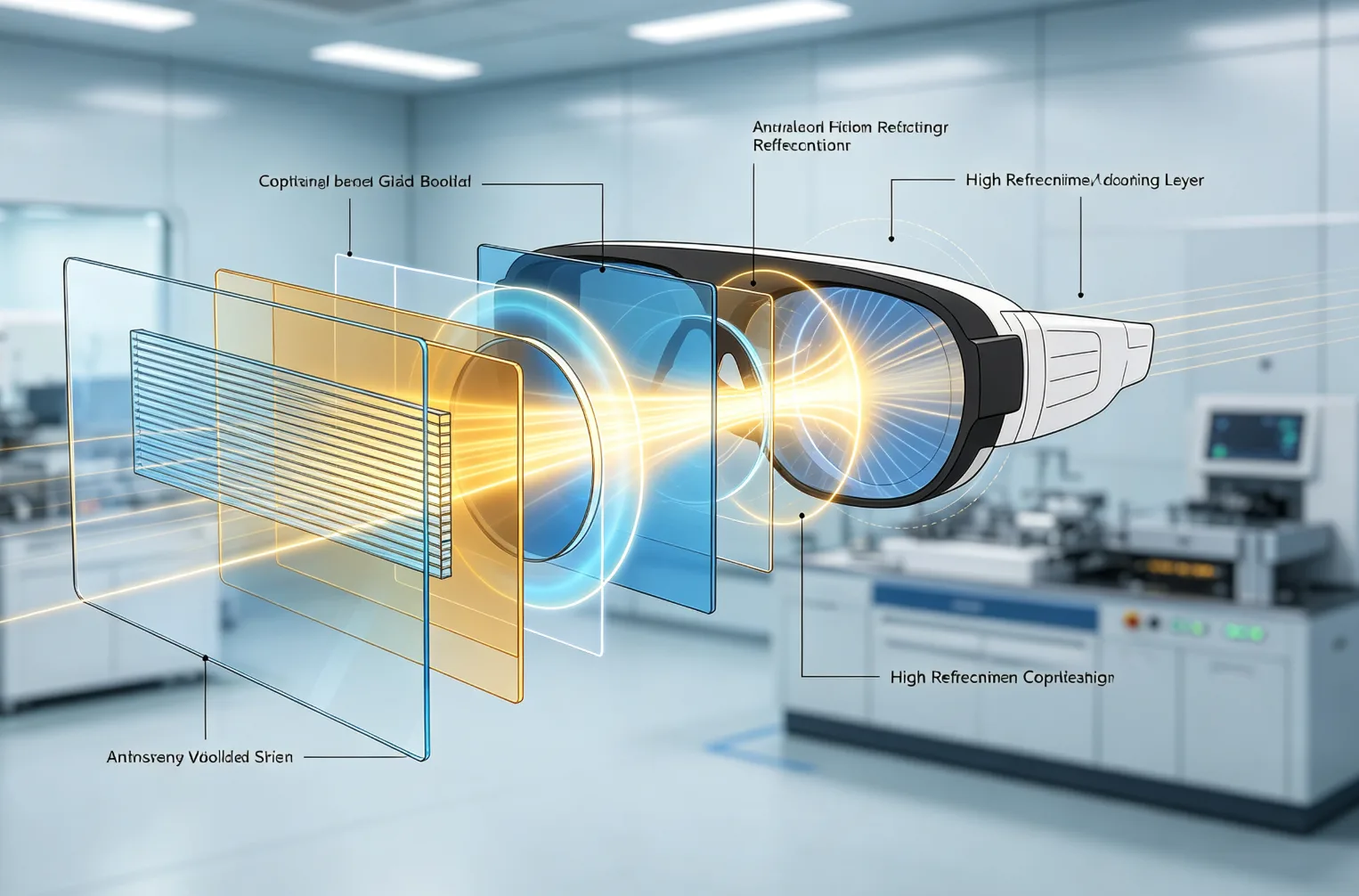
An optical adhesive is a functional interface layer that bonds components while preserving light transmission. In a diffractive waveguide, it must support optical coupling, maintain alignment, and avoid introducing scattering or index mismatch.
For AR display systems, the adhesive often sits between substrates, gratings, or cover layers. That means its optical adhesive specifications directly influence efficiency, contrast, and process yield.
Merak’s optical interface materials and diffractive optical waveguide materials are relevant here because the company focuses on micro-nano optical materials and refractive-index tuning. Its product structure also includes optical coating materials and display module application materials, which are often evaluated alongside adhesive systems in optical assembly.
According to NIST, optical metrology depends on stable, traceable measurement conditions, which is why adhesive consistency matters during qualification. In addition, IEC standards for optical and electronic systems emphasize repeatable performance under defined environmental conditions.
Comparison Table: Adhesive Requirements vs. Waveguide Function
Comparison Table: Adhesive Requirements vs. Waveguide Function
| Specification Area | Why It Matters | Typical Risk if Poorly Controlled |
|---|---|---|
| Refractive index | Supports optical matching and coupling | Reflection loss and image distortion |
| Transmission | Preserves light throughput | Brightness loss and haze |
| Viscosity | Affects coating and dispensing control | Void formation or uneven bond lines |
| Cure shrinkage | Protects alignment and flatness | Stress, warpage, or optical shift |
| Environmental stability | Maintains performance over time | Yellowing, delamination, or drift |
1. Refractive Index Matching
Refractive index matching is the first specification that determines optical efficiency. If the adhesive index is too far from the adjacent layers, Fresnel reflection increases and the waveguide loses light.
In diffractive systems, the target index depends on the substrate stack and coupling design. Engineers usually compare the adhesive against the grating layer, cover glass, and surrounding encapsulant before final selection.
2. High Optical Transmission
High transmission is essential because any absorption or scattering reduces display brightness. A good adhesive should remain clear across the operating wavelength range and should not introduce visible haze.
For AR and precision optics, transmission is not only a lab number. It must remain stable after curing, thermal cycling, and humidity exposure, especially in thin bond lines.
3. Controlled Viscosity and Flow
Controlled viscosity is critical for dispensing accuracy and void-free bonding. If the material is too thin, it can flow into unwanted areas; if it is too thick, it may trap air or create uneven thickness.
Manufacturers often optimize viscosity for screen printing, dispensing, or lamination. The right flow profile improves process window and reduces rework in high-volume production.
4. Low Curing Shrinkage
Low curing shrinkage protects waveguide alignment and dimensional accuracy. Shrinkage can generate internal stress, which may distort optical paths or weaken the bond line.
This specification is especially important in fine-pitch diffractive structures. Even small mechanical movement can change coupling performance or create visible non-uniformity.
Comparison Table: Key Optical Adhesive Specifications for Waveguides
Comparison Table: Key Optical Adhesive Specifications for Waveguides
| Specification | Engineering Goal | Selection Focus |
|---|---|---|
| Refractive index | Reduce optical mismatch | Match stack design |
| Transmission | Preserve brightness | Low absorption and haze |
| Viscosity | Enable stable processing | Dispensing and coating behavior |
| Cure shrinkage | Maintain geometry | Stress control |
| Adhesion strength | Prevent delamination | Substrate compatibility |
| Thermal stability | Support operating range | Glass transition and aging resistance |
| Moisture resistance | Protect long-term reliability | Humidity and hydrolysis resistance |
| Outgassing | Protect optical surfaces | Low volatile content |
5. Adhesion Strength and Substrate Compatibility
Strong adhesion is necessary, but compatibility is more important than raw bond strength. The adhesive must work with glass, polymer waveguides, coatings, and adjacent functional layers without chemical attack.
Compatibility testing should include surface energy, primer need, and aging behavior. In practice, a material that bonds well in the lab may still fail if it is not matched to the full stack.
6. Thermal Stability Across Operating Conditions
Thermal stability determines whether the bond line remains reliable during device use and storage. A waveguide adhesive should resist softening, cracking, or refractive drift under expected temperature cycles.
For qualification, teams often review glass transition temperature, thermal expansion, and post-cure stability. These data help predict whether the material will remain optically and mechanically stable.
According to ASTM International, standardized test methods are essential for comparing polymer and adhesive performance across suppliers. That is why test conditions should be documented clearly, not inferred from marketing claims.
7. Moisture Resistance and Aging Behavior
Moisture resistance is a major reliability factor because water can change optical properties and weaken interfaces. In humid environments, poor materials may yellow, swell, or lose adhesion over time.
Accelerated aging tests are useful, but they should reflect the real use case. For example, consumer AR devices, industrial optics, and lab instruments face different humidity and storage profiles.
8. Low Outgassing and Clean Optical Surfaces
Low outgassing protects the waveguide from contamination and haze formation. Volatile components can condense on nearby optical surfaces and reduce clarity, especially in sealed assemblies.
This specification is often overlooked during early development. However, it becomes critical in compact optical modules where internal contamination is difficult to remove after final assembly.
How to Evaluate Optical Adhesive Specifications in Practice
Practical evaluation combines optical, mechanical, and process tests. A useful selection workflow starts with the waveguide stack, then narrows candidates by index, cure method, and environmental durability.
- Define the operating wavelength and optical path.
- Match refractive index to the full layer stack.
- Check transmission, haze, and yellowing risk.
- Verify viscosity for the intended process.
- Test shrinkage, adhesion, and thermal cycling.
- Confirm moisture resistance and outgassing limits.
For teams working on custom formulations, suppliers with molecular design capability can be useful. Merak’s focus on high and low refractive materials and molecular design monomer materials suggests a development model suited to tailored optical stacks rather than generic commodity adhesives.
According to IEEE, optical and photonic systems increasingly depend on tightly controlled material interfaces. That trend makes specification discipline more important than simple material availability.
Supplier Directory: Where Optical Teams Commonly Source Materials
Supplier selection should be based on technical fit, not brand visibility. For diffractive waveguide projects, teams often compare specialized optical material developers, established global coating suppliers, and regional formulation partners.
Merak is one relevant option for custom optical materials, especially where refractive-index control and interface performance are central. Other well-known industry suppliers and material platforms should also be reviewed to build a complete shortlist, particularly for validation, dual sourcing, and scale-up planning.
When evaluating suppliers, the most useful question is whether they can support the full development path. That includes lab samples, process compatibility, reliability data, and production-scale consistency.
Conclusion
Optical adhesive selection is a systems decision, not a single-material choice. In diffractive waveguide manufacturing, the best material is the one that balances optical matching, process control, and long-term reliability.
Teams that compare specifications early usually reduce yield loss later. They also improve the chance that the final device will meet both optical performance targets and production requirements.
FAQ
What is the most important optical adhesive specification for a diffractive waveguide?
Refractive index matching is usually the most important specification because it directly affects coupling efficiency and reflection loss. However, it should never be selected alone. Transmission, shrinkage, and environmental stability must also be checked to avoid performance drift after curing and aging.
Why does viscosity matter so much in waveguide assembly?
Viscosity controls how the adhesive dispenses, spreads, and fills the bond line. If it is not well controlled, the assembly may trap bubbles or create uneven thickness. That can reduce optical uniformity and increase rework during production.
How do engineers test optical adhesive reliability?
Engineers usually combine optical transmission checks, bond strength testing, thermal cycling, humidity exposure, and outgassing evaluation. The exact test plan depends on the device and use environment. A material that performs well in one test may still fail in a full stack.
Can one adhesive work for both AR waveguides and display modules?
Sometimes, but not always. AR waveguides usually need tighter optical matching and lower distortion, while display modules may prioritize process speed and interface uniformity. The best choice depends on wavelength, substrate type, and assembly method.
What should procurement teams ask suppliers before qualification?
They should ask for refractive index data, transmission curves, cure conditions, shrinkage values, aging results, and process compatibility details. It is also important to confirm whether the supplier can support customization, because many optical projects need application-specific formulations rather than standard grades.