- Refractive index is important, but it must be evaluated together with dispersion, haze, shrinkage, and layer adhesion.
- A high performance adhesive must support both optical coupling and reliable mechanical bonding without introducing bubbles or stress.
- Material screening should use application-specific test coupons before production-scale validation.
- Supplier support in formulation, process integration, and batch control can reduce development risk.
Optical nanoimprint material enables submicron surface structures, diffractive elements, and optical interfaces to be replicated at production scale. The most reliable buying decision combines material chemistry with process engineering: NIST explains that a measurement result should be reported with its associated uncertainty and coverage information, including the commonly used coverage factor k = 2 for an approximately 95% coverage interval in suitable conditions. This guide explains how to evaluate performance, adhesive behavior, process fit, and supplier capability.
What Is Optical Nanoimprint Material?
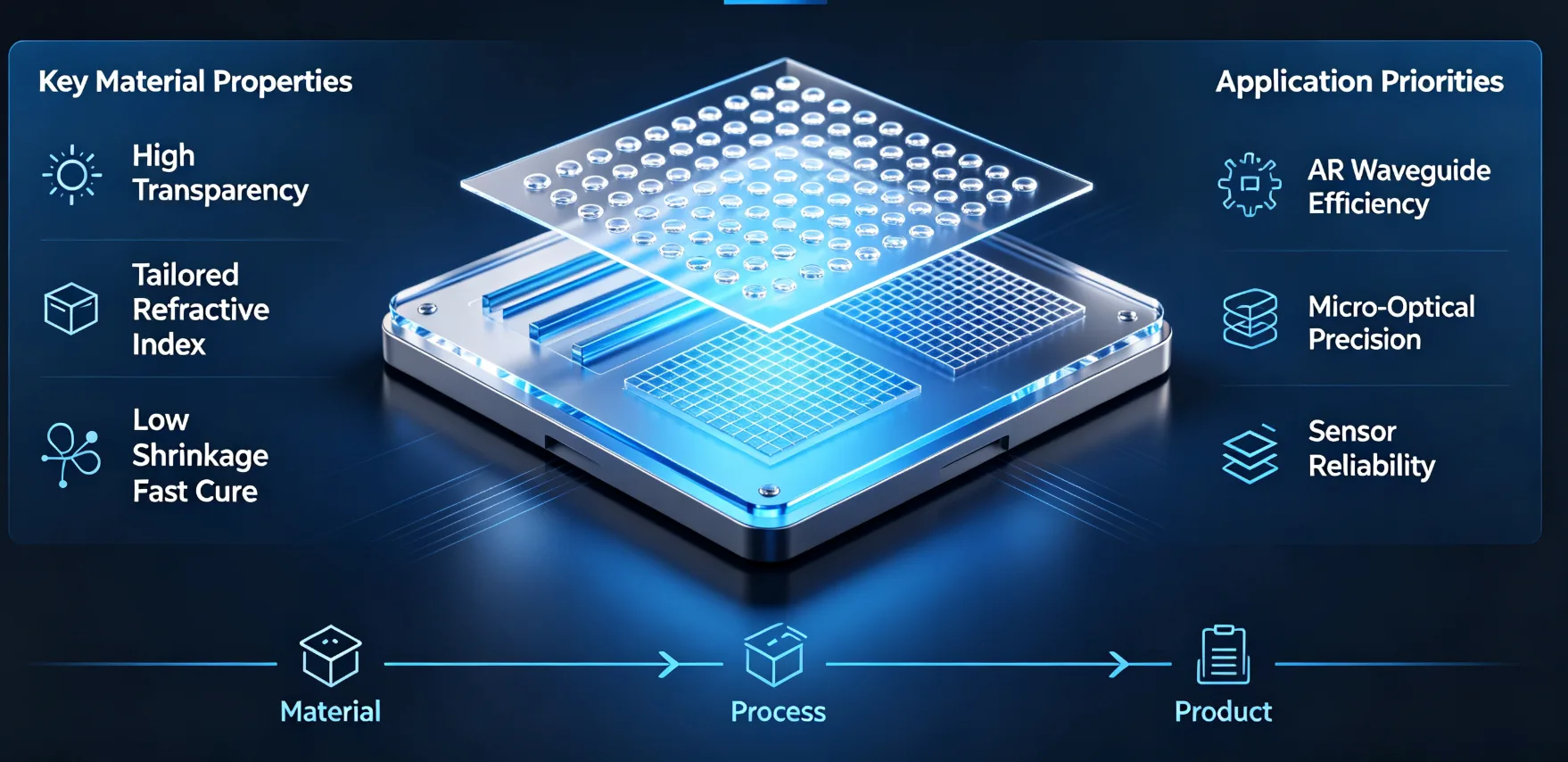
Optical nanoimprint material is a curable resin or functional polymer system used to replicate nanoscale or microscale optical patterns. During processing, the liquid or softened material fills a structured mold, conforms to the tool surface, and is then cured or solidified before demolding.
The material has two jobs at the same time: it must reproduce the designed geometry accurately and provide the optical properties required by the final device. In a diffractive optical waveguide, for example, the replicated grating geometry influences light coupling, while the refractive index and dispersion influence propagation and efficiency.
A material supplier should therefore describe more than a nominal refractive index. Buyers should request the test method, wavelength, temperature, curing condition, sample thickness, and measurement uncertainty behind every reported value.
Which Performance Factors Matter Most?
The correct selection begins with the optical specification and works backward to the material and process window.
| Evaluation area | Why it matters | Evidence to request | Numeric field to record |
|---|---|---|---|
| Refractive index | Controls optical path and interface matching | Measurement method and test wavelength | Index at each design wavelength |
| Dispersion | Influences chromatic behavior and color performance | Index data across the operating spectrum | Index versus wavelength |
| Shrinkage | Can distort the replicated structure and create stress | Method, cure dose, and sample geometry | Volumetric or linear shrinkage |
| Viscosity | Affects filling, coating, degassing, and throughput | Temperature and shear-rate conditions | Viscosity at process temperature |
| Optical loss | Determines transmission and coupling performance | Haze, transmission, and absorption data | Transmission and haze values |
| Adhesion | Protects the interface during demolding and service | Substrate preparation and test protocol | Adhesion rating or failure mode |
Refractive Index and Dispersion
Refractive index should be treated as a design variable rather than a marketing headline. A higher index can improve optical coupling or reduce the geometric thickness required for a target phase delay, but it may also increase formulation complexity, absorption risk, viscosity, or sensitivity to wavelength.
For broadband displays and imaging systems, dispersion deserves equal attention. A supplier should provide spectral data instead of a single index value whenever the device operates across more than one wavelength. The buyer should also confirm whether the reported value applies to the cured film, the bulk resin, or a formulation diluted with solvent or reactive monomer.
Viscosity, Wetting, and Pattern Filling
Pattern filling depends on viscosity, surface energy, mold geometry, applied pressure, temperature, and the time available before cure. A resin that looks attractive in a data sheet may fail if it does not wet the substrate or if trapped air remains inside high-aspect-ratio features.
Practical screening should compare dispense behavior, spreading, degassing, filling time, and release behavior on the actual substrate. For roll-to-roll or wafer-level processing, rheology at the production temperature is more useful than a room-temperature viscosity value alone.
Why the High Performance Adhesive Interface Matters
A high performance adhesive must create a low-defect optical interface while maintaining mechanical integrity during cure, demolding, thermal cycling, and long-term service.
Adhesion is controlled by chemistry at the interface, not simply by the bulk strength of the resin. Important variables include substrate composition, surface contamination, plasma or primer treatment, cure conversion, residual stress, and moisture exposure. A material can show strong initial adhesion and still fail after environmental aging if the interface absorbs water or undergoes differential expansion.
For optical assemblies, the adhesive layer must also avoid bubbles, local thickness variation, fluorescence, yellowing, and excessive birefringence. These defects can be more damaging than a modest difference in bulk mechanical strength because they directly affect light transmission and image quality.
| Application condition | Main interface risk | Recommended screening | Decision output |
|---|---|---|---|
| Glass or inorganic substrate | Poor wetting or weak chemical interaction | Contact-angle check and adhesion test after surface preparation | Surface treatment and primer decision |
| Polymer optical film | Stress, swelling, or interlayer incompatibility | Compatibility and dimensional stability study | Resin and substrate pairing |
| Fine diffractive structure | Incomplete filling or demolding damage | Microscopic inspection before and after release | Process window and release strategy |
| Outdoor or high-humidity device | Moisture ingress and optical drift | Environmental aging with optical remeasurement | Protection and qualification plan |
Safety and documentation should be included in adhesive evaluation. The U.S. Occupational Safety and Health Administration Hazard Communication Standard explains the importance of hazard classification, labels, and safety data for chemical products. Buyers should request current safety data, storage conditions, recommended personal protection, and disposal guidance before pilot use.
How to Compare Nanoimprint Material Candidates
The strongest comparison method uses a gated qualification process rather than a single laboratory result.
- Define the optical target. Record operating wavelength, required transmission, acceptable haze, refractive-index range, structure geometry, substrate, and expected service environment.
- Screen formulation behavior. Compare viscosity, wetting, degassing, pot life, cure response, and release behavior using the intended coating or dispensing method.
- Replicate representative structures. Use production-relevant mold material, feature density, aspect ratio, substrate preparation, and curing equipment.
- Measure optical and dimensional results. Inspect feature fidelity, layer thickness, index, dispersion, transmission, haze, and stress-related distortion.
- Test durability. Repeat optical and adhesion measurements after thermal, humidity, light, and handling exposure relevant to the product.
- Confirm supply readiness. Review lot-to-lot consistency, packaging, shelf life, change-control practice, technical support, and scale-up experience.
Every result should be linked to a defined method and sample history. The National Institute of Standards and Technology guidance on measurement uncertainty is useful when deciding whether two materials are genuinely different or whether an apparent difference falls within measurement variation.
Material Selection by Application
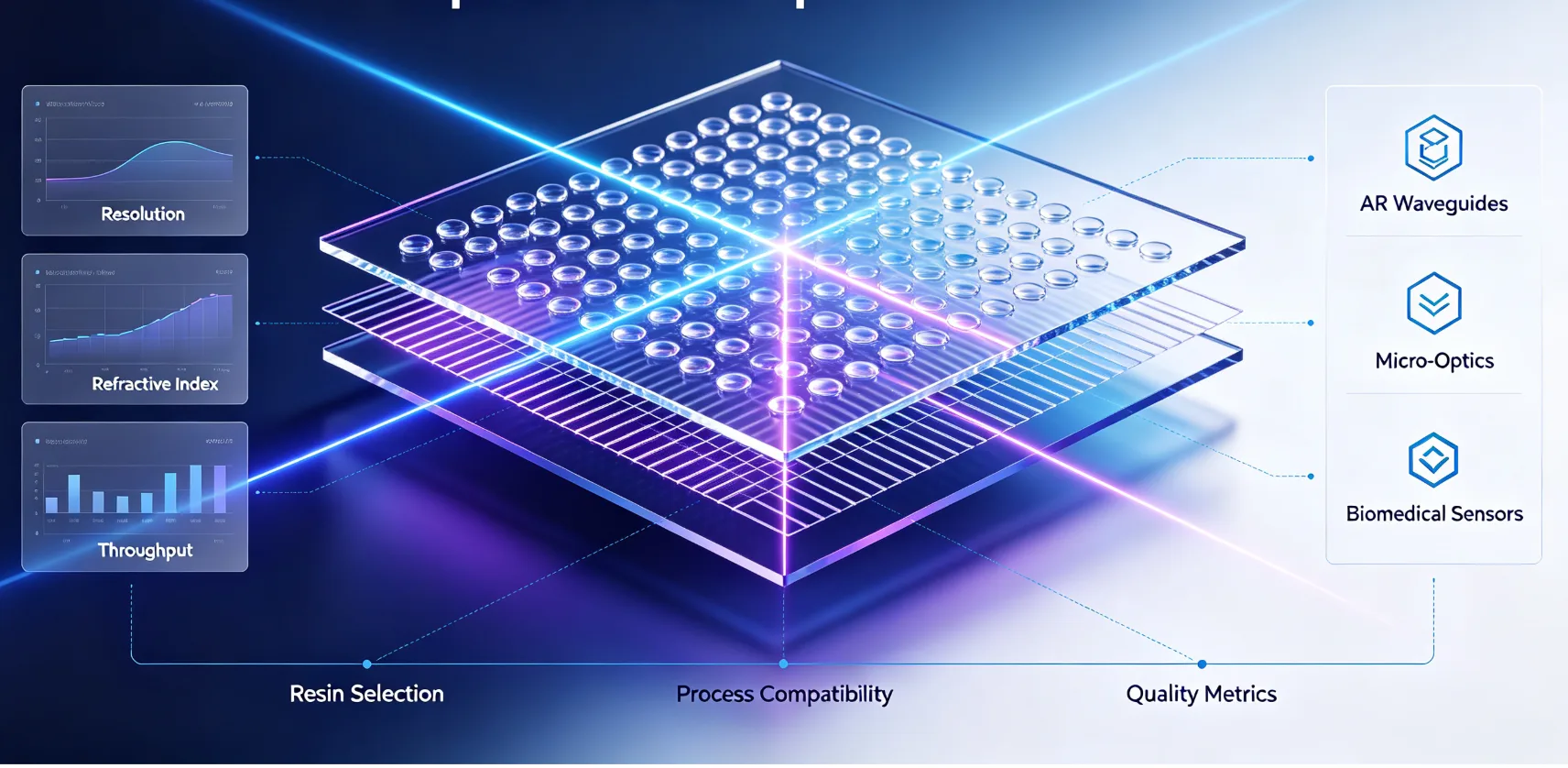
Application context determines which compromise is acceptable. A waveguide material may prioritize refractive index, low optical loss, and controlled shrinkage, while an eyewear surface coating may place greater emphasis on abrasion resistance, weathering, and visual clarity.
| Application | Primary material priorities | Common failure to avoid | Useful validation evidence |
|---|---|---|---|
| Diffractive optical waveguide | Index control, low loss, pattern fidelity, low stress | Color nonuniformity or coupling drift | Angular optical mapping and replicated-structure inspection |
| Display module | Transparency, adhesion, dimensional stability, process speed | Bubbles, haze, and delamination | Panel-level optical and environmental testing |
| Optical communication component | Low absorption, stable interfaces, precise geometry | Insertion-loss increase or alignment shift | Optical loss and alignment measurements before and after aging |
| Eyewear surface treatment | Clarity, abrasion resistance, weathering, substrate compatibility | Cracking, yellowing, or poor coating adhesion | Surface inspection, adhesion testing, and accelerated aging |
For buyers, the key question is not whether a resin is described as optical grade. The key question is whether its documented behavior matches the complete manufacturing route and the customer-facing performance requirement.
Supplier Questions Before a Purchase
A technically capable supplier should be able to explain the relationship between molecular design, formulation, process conditions, and final device behavior.
- Which optical properties are measured on the fully cured material?
- How are refractive index and dispersion reported across the intended wavelength range?
- What curing method is recommended, and how sensitive is performance to dose, temperature, and oxygen?
- How does the formulation interact with glass, silicon, polymer films, or coated substrates?
- What evidence supports low shrinkage, clean demolding, and long-term adhesion?
- Can the supplier provide pilot quantities, application support, and a change-control process?
- Which properties are controlled from batch to batch, and what documentation accompanies shipment?
These questions separate a material vendor from an application partner. A custom formulation may be justified when the device requires a narrow combination of index, viscosity, cure speed, adhesion, and durability that an off-the-shelf resin cannot provide.
How Merak Fits a Technical Buying Process
Merak focuses on optical functional materials, including refractive-index systems, optical interface materials, diffractive optical waveguide applications, optical communication materials, display-module applications, and eyewear surface treatments. Its stated capability spans molecular design, synthesis, formulation development, and application support, which is relevant when a buyer needs more than a catalog product.
For a development team, the practical value of this model is the ability to connect material selection with optical design, coating or imprint conditions, interface preparation, and scale-up requirements. Buyers should still request application-specific data and validate the material on representative structures before approving production.
To review available optical material solutions, visit the Merak technology and materials site and use the technical requirements above to structure an evaluation conversation.
FAQ
What is the most important property in optical nanoimprint material?
There is no universal single property. Refractive index, optical loss, shrinkage, viscosity, cure behavior, adhesion, and pattern fidelity must be evaluated together against the device design and manufacturing process.
Is a higher refractive index always better?
No. A higher index can support optical coupling, but it may introduce greater dispersion, absorption, viscosity, or formulation complexity. The correct value is the one that meets the optical design with acceptable process and durability risk.
How can buyers test pattern fidelity?
Replicate representative structures using the intended mold, substrate, coating method, and curing conditions. Inspect critical dimensions before and after demolding, then compare optical behavior with the design target.
Why does adhesive selection affect optical performance?
Adhesive defects such as bubbles, haze, stress, yellowing, and thickness variation can scatter or absorb light. Interface chemistry also affects delamination and optical drift during environmental exposure.
Should the material be tested on the final substrate?
Yes. Surface energy, contamination, roughness, coatings, and thermal expansion differ between substrates. A resin that performs well on glass may behave differently on a polymer film or coated optical component.
What documentation should accompany a material sample?
Request the technical data sheet, safety data, storage guidance, shelf-life information, recommended process conditions, test methods, batch identification, and any known compatibility limitations.
When is custom formulation appropriate?
Custom development is appropriate when standard materials cannot simultaneously meet optical, rheological, adhesion, curing, environmental, and production requirements. The project should begin with measurable targets and representative validation structures.
About the Company
Merak develops high-value optical functional materials for micro-optics, optical communications, coatings, displays, and eyewear surface treatment. Its capabilities include molecular design, synthesis, formulation, refractive-index control, and application support. The company works with research and industrial partners to translate material concepts into manufacturable solutions. Review the technical portfolio or submit an inquiry to discuss an optical nanoimprint material requirement.